
stop guessing who has access to your systems
We map every AI tool, SaaS application, and identity across your company: what's in use, what data it touches, who approved it.
Then we fix what needs fixing
Our key security partners:






.svg.png)




of leaders saw harm from a former employee's access
2022
•
Beyond Identity
of manual offboarding misses SaaS applications
2026
•
Reco
of intrusions are malware-free, where attackers log in
2026
•
CrowdStrike
your stack is likely leaking access in three places
ai exposure
Personal ChatGPT or Claude accounts handling company data.
AI browser extensions installed without audit trail.
Connector apps pulling content into AI models.
Tools training on your internal data, on terms nobody read.
saas sprawl
OAuth grants nobody approved, reading emails and documents.
Trial integrations from 18 months ago, still active.
Shadow apps connected to your directory without IT review.
Licenses you pay for, nobody uses.
identity leaks
Former employees still in the directory
Active users without MFA
Admin accounts running unprotected
three areas,
one problem: visibility
The access chaos, the SaaS sprawl, and the AI tool risk are mostly symptoms of the same thing:
the company grew faster than the infrastructure that governs it.
We work across all three because fixing one without the others doesn't hold.
thirty minutes, six areas. your real AI picture
A free call with a practitioner, built around an 18-question checklist we send you first. You score yourself before we talk, so the call starts where the gaps are.
We go through six areas: discovery, data exposure, agents and automations, AI identities and access, incident readiness, governance. You leave with your three next moves. No deck, no demo, no obligation.
If the honest answer is that you're fine, that's the answer you get.
what you find out
Which AI tools are actually in use, including the ones on personal accounts. What company data flows into them. Which agents and integrations hold access nobody reviews.
what you walk away with
A scored self-assessment across six areas, a read on what your score means for a company your size, and three concrete next steps. Yours to keep either way.
Trusted by:

we map it all & then we show you what to fix first
Most security reports tell you what's wrong and leave you to figure out what to do. Ours don't.
Every finding gets a priority (P0, P1, P2) and a concrete next move. What to do, in what tool, whether you need additional licenses.
ghost accounts and abandoned access
Former employees still authenticating six months after they left. Contractors whose project ended in 2024. Service accounts created by developers who don't work here anymore.
unauthorized integrations and shadow apps
OAuth grants nobody approved, with full mailbox read scope. SaaS apps connected to your directory without IT review. AI tools pulling content from internal systems through forgotten API keys.
privilege creep and admin sprawl
Accounts with permissions far beyond their role. Admin counts that multiplied during one-off projects and never got rolled back. Service accounts set as admins because it was easier at the time.
Trusted by:
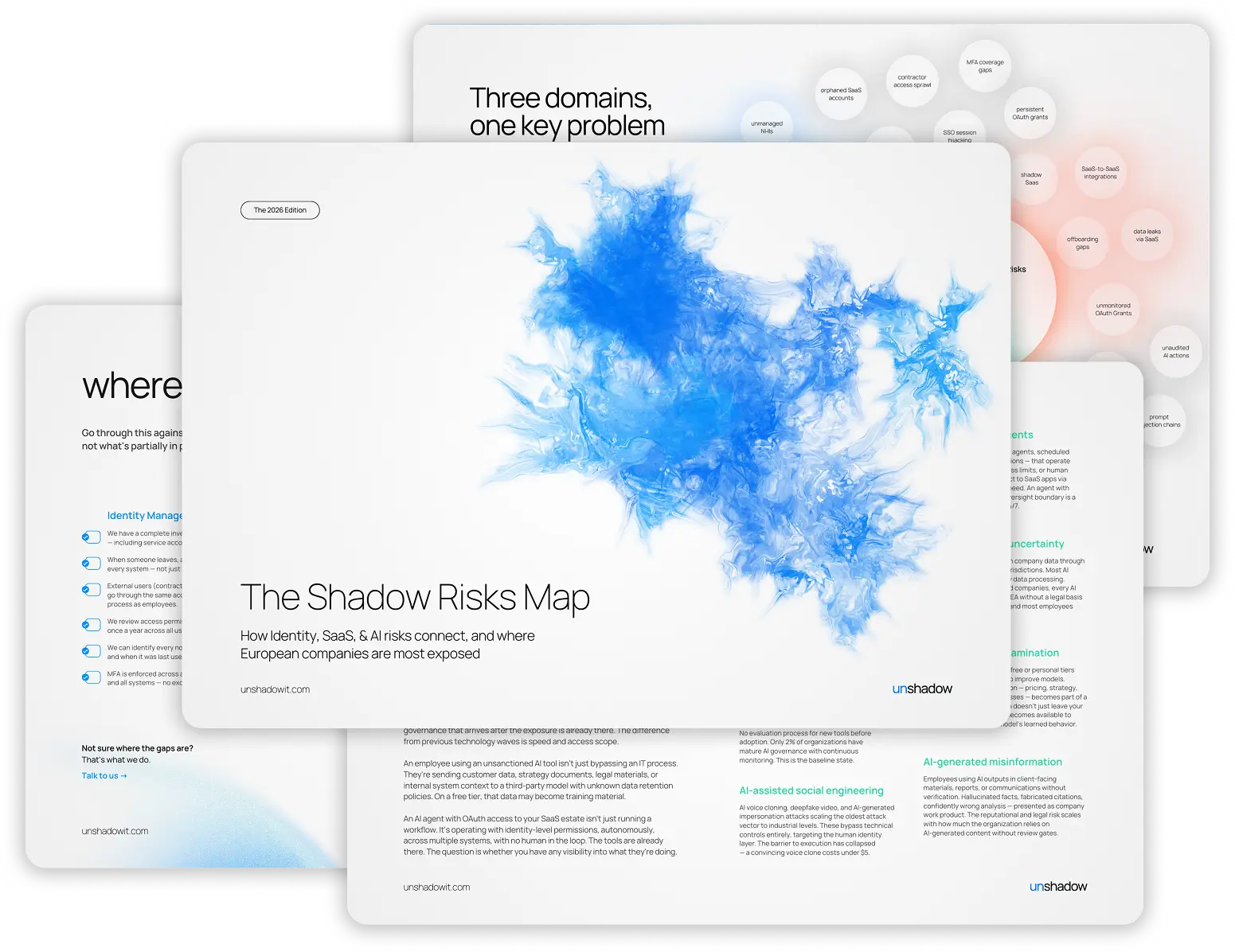
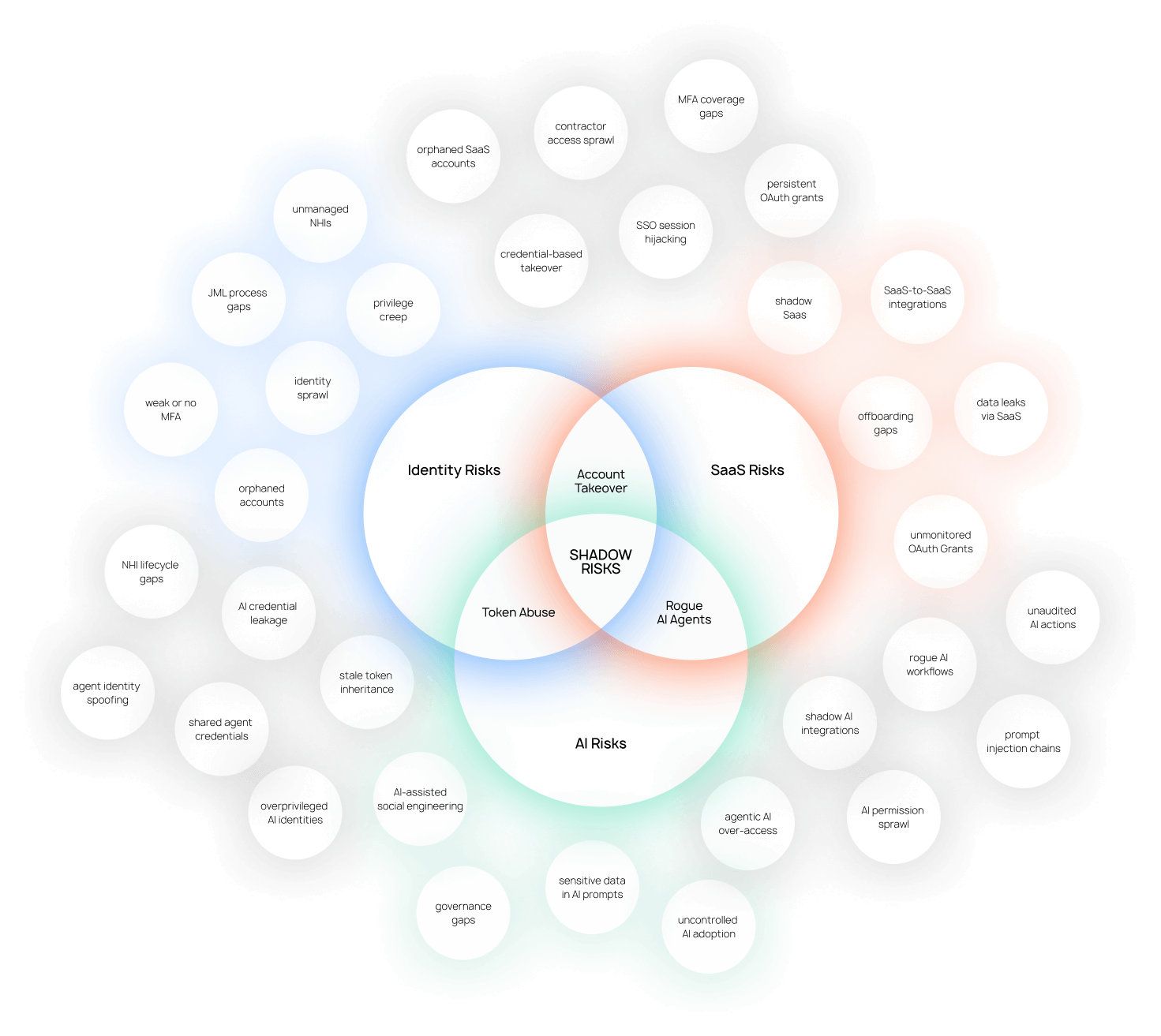
get to know the full picture of shadow risks emerging in 2026
The full map with detailed risk breakdowns across Identity, SaaS, and AI, how they connect at the intersections, and a 17-point self-assessment checklist to see where your company actually stands today.
Share it with your team. Use the checklist in your upcoming security review. Pin the map where your IT team can see it.
practitioner guides on identity, access, and operational security
NIS2 for mid-market: what IT actually has to do
How to build a mid-market security program using the NIST CSF
How to choose tooling for non-human and machine identity security
Non-human identities: securing service accounts, workload identities, and AI agents
Browser security for mid-market: the new endpoint nobody is watching
How to govern AI use in your company: a framework for European organizations
three areas where we work
the access scan is the entry point for most clients, but identity, SaaS, and AI security each go deeper - here's where each leads
Your team's AI use is real.
Your visibility into it mostly isn't
WatchGuard's 2026 survey of 50-500 person companies found 64% of employees using AI tools nobody approved, and fewer than 30% of companies keeping an accurate inventory of the software in use.
Harmonic's telemetry adds the sharper half: 64.5% of activity on personal AI accounts is work. Company data, private account.
Banning everything doesn't work either. We've watched that play out. People use the tools anyway, just less visibly.
Where this goes deeper:
AI tool discovery across the organisation
Risk assessment by tool and use case
Acceptable use policy
Approved tools framework
GDPR and further compliance review
Tool selection for monitoring and governance
Your team is already using tools you don't know about
At 100 people, the average company runs 200+ SaaS tools.
IT knows about 60 of them.
The rest sit on personal cards, free tier accounts, and that recurring charge nobody can explain. Each one processing personal data is a gap in your GDPR register. Each one is a door you don't control.
Where this goes deeper:
Full SaaS discovery and inventory
Shadow app identification and risk assessment
Tool selection matched to your size and needs
App request and approval workflow
You probably have more active accounts than active employees
Former contractors still in Slack. Developers with admin rights from a role they left two years ago. Offboarding that happens in HR only.
The result is that you can't answer the question any auditor or enterprise client will eventually ask: who has access to your systems right now, and why?
Where this goes deeper:
Identity audit across your full tool stack
SSO, directory, and MFA setup
Joiner, mover, leaver process design
Offboarding automation
Quarterly access review cadence
Tool selection sized to your company
